Blog › Client Acquisition
Customer Retention Strategies: How Small Businesses Keep Customers Coming Back
Updated September 28, 2026
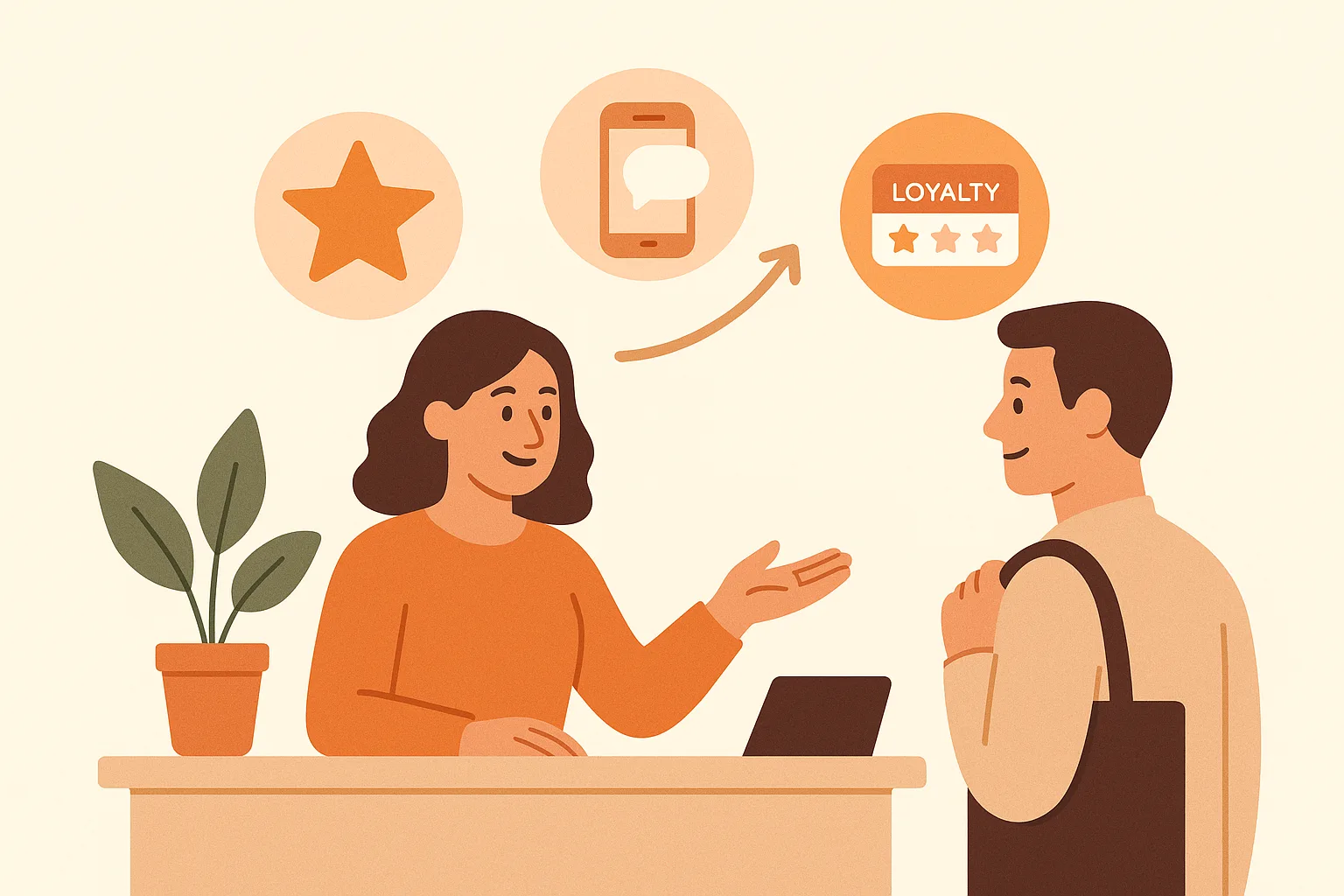
Short answer: The best customer retention strategies for a small business are simple and repeatable: book or remind the next visit before the customer leaves, follow up at the moments they are likely to need you again, reward loyalty in a way that fits how often people buy, win back lapsed customers with a personal message and track your repeat rate every month. Most of it costs time, not money, and it works best when every customer goes through the same routine.
This guide is for service businesses and local shops in the US and UK, such as salons, clinics, trades, cafés, cleaners and studios. It covers what to do at each stage of the customer's journey, which loyalty model suits your business, how to use WhatsApp, text and email without breaking the rules, and how to measure whether it's working.
Key takeaways
- Retention starts at the first visit: the experience, the next-booking question and a quick thank-you do more than any loyalty scheme.
- Build a follow-up timeline based on how often your customers actually need you (every 6 weeks for a haircut, every year for a boiler service).
- Choose a loyalty model that fits your buying cycle: stamp cards for frequent visits, memberships for regular services, referral rewards for rare purchases.
- Send a personal win-back message when a customer is overdue, before they forget you and try a competitor.
- Get clear consent before sending marketing texts and WhatsApp messages; US and UK rules differ.
- Measure your repeat customer rate and time between visits every month, so you know whether your changes help.
What is customer retention, and why does it matter for a small business?
Customer retention is your ability to keep customers coming back after their first purchase. For a small business, repeat customers make revenue more predictable, fill quiet days, cost little to reach and are the main source of referrals and reviews. A business that keeps most of its customers can grow with a modest flow of new ones; a business that loses most of them has to keep paying to replace them.
Retention is not a separate marketing channel. It is the part of your client acquisition strategy that protects the money you already spent winning each customer. Getting new customers and keeping them should be planned together.
Your realistic target depends on your business. A dog groomer or hair salon might expect regulars every few weeks. A roofer or wedding photographer rarely sells to the same person twice, so for them "retention" means staying remembered for referrals, reviews and the occasional repeat job.
| Business type | Typical buying cycle | What retention looks like |
|---|---|---|
| Hair, nail, lash and barber shops | Every 2 to 8 weeks | Pre-booking the next appointment, rebooking reminders, memberships |
| Cafés, bakeries, small shops | Weekly or more | Stamp cards or apps, regulars' perks, seasonal reasons to visit |
| Cleaners, gardeners, pool and pest services | Weekly to quarterly | Recurring schedules, service plans, reliable communication |
| Clinics, physical therapists (physiotherapists), dentists | Course of treatment, then yearly checks | Completing the plan, recall reminders, maintenance visits |
| Trades (HVAC, plumbing, electricians) | Yearly service or rare repairs | Annual service reminders, maintenance plans, referral asks |
| Photographers, planners, one-off projects | Once, sometimes years apart | Staying in touch, anniversary or milestone offers, referrals |
How do you keep a customer after their first visit?
Treat the first visit as the start of a relationship and end it with a clear next step. Customers who leave without a reason to come back tend to drift, even when they were happy.
- Deliver what you promised, on time. Lateness, surprise charges and messy handovers undo good work. No loyalty scheme fixes a disappointing first experience.
- Learn one or two personal details. Note the customer's preferences in your booking system or customer notes: the color formula, the dog's anxiety, the rooms they care most about.
- Recommend the next step before they leave. "Your color will need a refresh in about six weeks. Shall I book you in?" is a service, not a sales pitch.
- Send a short thank-you within 24 hours. Include aftercare tips if relevant and one easy way to rebook.
- Ask for feedback, then a review. Ask privately how it went; if they're happy, send your Google review link (our guide to getting more Google reviews has templates).
Pre-booking at checkout is one of the simplest retention tools for appointment-based businesses. Most booking apps can send a reminder a day or two before, and customers who already have a date in the diary are less likely to shop around.
What follow-up timeline keeps customers coming back?
Base your follow-ups on how often each customer needs you, not on a fixed newsletter date. A reminder that arrives just as the customer starts thinking "I need a haircut" or "the boiler hasn't been serviced" feels helpful rather than pushy.
| When | Message | Channel |
|---|---|---|
| Day 1 | Thank you, aftercare or care tips, how to reach you | Text, WhatsApp or email |
| Days 3 to 7 | Quick feedback check, then review request if happy | Text or email |
| Just before the usual interval | Rebooking reminder with a direct booking link | Whichever channel they prefer |
| Overdue by about half an interval | Personal check-in: "We haven't seen you for a while" | Personal text or call |
| Seasonal | Relevant reminder, such as a pre-winter furnace check or a pre-holiday booking slot | Email or text to opted-in customers |
| Yearly | Anniversary of first visit, annual service due, or a thank-you to long-term customers | Email or card |
Keep messages short and specific. "Hi Sarah, it's been seven weeks since your last cut. Want Thursday at 5pm again?" works better than a generic newsletter. If you run the timeline manually at first, a simple spreadsheet with each customer's last visit date and preferred channel is enough.
Which loyalty program works best for a small business?
The best loyalty program matches how often your customers buy and how much each visit is worth. A points app is wasted on a business people visit once a year, and a referral bonus alone won't keep café regulars loyal.
| Loyalty model | Best for | How it works | Watch out for |
|---|---|---|---|
| Stamp card or digital punch card | Cafés, barbers, car washes | Every 8th or 10th visit gets a free item or discount | Too many visits needed before the reward |
| Membership or subscription | Salons, massage, cleaning, gyms, car care | Monthly fee for a set service plus member perks | Unclear cancellation terms; auto-renewal laws |
| Prepaid packages | Clinics, tanning, lessons, grooming | Buy 5 or 10 sessions at a lower price per session | Expiry dates and refund terms must be fair and clear |
| Service or maintenance plan | HVAC, plumbing, pest control, pool care | Annual fee covers scheduled visits and priority booking | Delivering the scheduled visits reliably |
| VIP or tiered perks | Boutiques, restaurants, beauty retail | Early access, private events, birthday treats | Perks that cost more than they return |
| Referral rewards | Trades, photographers, any low-frequency business | Customer and friend both get a credit or gift | Rewards that feel like payment for reviews (not allowed) |
Price memberships and packages so they still earn you money when customers use every session. Work out your real cost per visit first; our free service pricing calculator helps you set a price that covers your time, costs and profit before you discount it.
How can you use WhatsApp, text and email for retention?
Use each channel for what customers expect from it: text or WhatsApp for reminders and quick personal messages, email for longer updates and seasonal offers. Ask customers which channel they prefer when they book, and record their consent.
- WhatsApp: popular with customers in the UK and many other countries, less so in the US. The WhatsApp Business app is fine for a one-person business; larger teams often use the WhatsApp Business Platform through a provider. WhatsApp's own policies require that customers have opted in to receive your messages.
- Text (SMS): the most direct option in the US for appointment reminders. Keep marketing texts rare and useful.
- Email: best for monthly news, seasonal offers and anything longer than a few lines. Segment it: a lapsed customer and a weekly regular should not get the same email.
- Phone calls: underrated for high-value customers who have gone quiet. A friendly call is often the best win-back message you can send.
How do you win back customers who stopped coming?
Win back lapsed customers by contacting them personally, finding out why they stopped, and giving them an easy way to return. Many customers leave for ordinary reasons, such as a busy month or moving house, not because they were unhappy.
- Define "lapsed" for your business, for example twice the customer's usual interval without a visit.
- Send a personal message, not a blast: "Hi Tom, we haven't seen Max for a groom since spring. Everything OK?"
- Listen to the answer. If there was a problem, apologize and fix it; that conversation alone often brings people back.
- Make returning easy with a direct booking link or two suggested times. Add a small welcome-back offer only if needed.
- Log the reason they left. Patterns (price, parking, one staff member, long waits) tell you what to fix.
What rules apply to loyalty programs and retention messages in the US and UK?
Marketing messages, subscriptions and review requests are regulated in both countries. The table covers the main areas; it is not legal advice, so check your local rules and your platform's policies.
| Area | United States | United Kingdom |
|---|---|---|
| Marketing texts and calls | TCPA: prior express written consent for automated marketing texts; National Do Not Call Registry; some states add their own rules | PECR and UK GDPR: consent needed for marketing texts and emails, or the "soft opt-in" for existing customers buying similar products, with an easy opt-out |
| CAN-SPAM: accurate sender details, a physical address and a working unsubscribe link | PECR and UK GDPR as above; include an unsubscribe option in every message | |
| Memberships and auto-renewal | State automatic renewal laws (for example California's) require clear terms and easy cancellation | Consumer Rights Act 2015 fairness rules; the DMCC Act 2024 subscription rules are being phased in, so check the current start date |
| Gift cards and prepaid credit | Federal law (Credit CARD Act) generally stops gift cards expiring within five years; states may add more | Expiry terms must be clear and fair under consumer law |
| Reviews and incentives | FTC rule on fake reviews bans rewards conditioned on positive reviews; Google does not allow incentives for reviews | DMCC Act 2024 bans fake reviews and incentivized reviews that aren't disclosed; Google's policy applies too |
The safe pattern: ask for consent at booking, say what you'll send and how often, make stopping easy, and never tie a reward to a review.
How do you measure customer retention?
Track two or three simple numbers every month from your booking system, point-of-sale or a spreadsheet. The trend matters more than any single figure.
| Metric | How to calculate it | What it tells you |
|---|---|---|
| Repeat customer rate | Customers with 2+ purchases in the period ÷ all customers in the period | How many people come back at all |
| Customer retention rate | (Customers at end of period − new customers gained) ÷ customers at start × 100 | How many existing customers you kept |
| Rebooking rate | Appointments where the next visit was booked at checkout ÷ all appointments | Whether your team asks, and whether customers say yes |
| Average time between visits | Average days between a customer's purchases | Whether regulars are stretching their intervals |
| Lapsed customers won back | Customers who returned after a win-back message ÷ messages sent | Whether your win-back routine works |
Pick a time window that fits your cycle: monthly for a café, quarterly for a salon, yearly for a trade. If you want these goals written into a simple plan alongside your acquisition goals, try our free marketing plan generator.
Common customer retention mistakes
- Only focusing on new customers. Big discounts for first-timers can annoy loyal regulars who pay full price.
- Waiting for customers to rebook themselves. Busy people forget; ask at checkout and remind them later.
- Sending the same message to everyone. A weekly regular and a customer who hasn't visited in a year need different messages.
- Loyalty rewards that take too long. If the reward needs 20 visits, most customers never reach it and stop caring.
- Memberships that are hard to cancel. Customers resent it, it risks breaking auto-renewal and consumer rules, and it produces bad reviews.
- Rewarding reviews. Offering a discount for a review breaks Google's policy and can break the FTC rule (US) and DMCC Act (UK).
- Not tracking anything. Without a repeat rate, you can't tell whether a new idea helped or hurt.
Frequently asked questions
What are the best customer retention strategies for a small business?
Book or suggest the next visit before customers leave, send a thank-you and timely reminders, offer a loyalty model that fits how often people buy, send personal win-back messages to lapsed customers and track your repeat rate monthly. Consistency matters more than any single tactic.
How do you calculate customer retention rate?
Take the number of customers at the end of a period, subtract the new customers gained during it, divide by the number of customers at the start, and multiply by 100. For many small businesses, the repeat customer rate (customers with two or more purchases divided by all customers) is simpler to track.
Is a loyalty program worth it for a small business?
It can be, if it suits your buying cycle and the reward is reachable. A stamp card suits a café or barbershop; a membership or prepaid package suits regular services; a referral reward suits businesses customers use rarely. Work out the cost of the reward before you launch it.
How often should you contact existing customers?
Contact them around the time they're likely to need you again, plus the occasional seasonal or yearly message. For most small businesses that means a thank-you, a reminder before the usual interval and a check-in if they're overdue, rather than weekly marketing.
Can I send WhatsApp or text messages to past customers?
Only with the right consent. In the US, the TCPA generally requires prior express written consent for automated marketing texts. In the UK, PECR requires consent or the soft opt-in for existing customers, with an easy way to opt out. WhatsApp also requires customers to opt in. Appointment reminders a customer asked for are treated differently from marketing, so check your local rules.
How do you get lost customers back?
Send a personal message asking how they are, listen to any problem and fix it, then make it easy to rebook with a link or suggested times. Use a small welcome-back offer only when needed, and record why customers left so you can fix common causes.
Want more repeat clients and fuller days? Practical Strategies to Double Your Salon Bookings and Revenue by Damien Rosewood includes loyalty packages, referral programs, messaging campaigns and review routines. It's written for salons, and most ideas work for any appointment-based business.